· Ernie Braganza · Blog article · 8 min read
Who Owns the News in Southwest Virginia?
Almost nobody who lives here. The FCC just removed the last federal limit on how big broadcast owners can get — here's how that, plus newspaper consolidation and lost public broadcasting funding, is playing out in our own media market.
Last updated: August 7, 2026
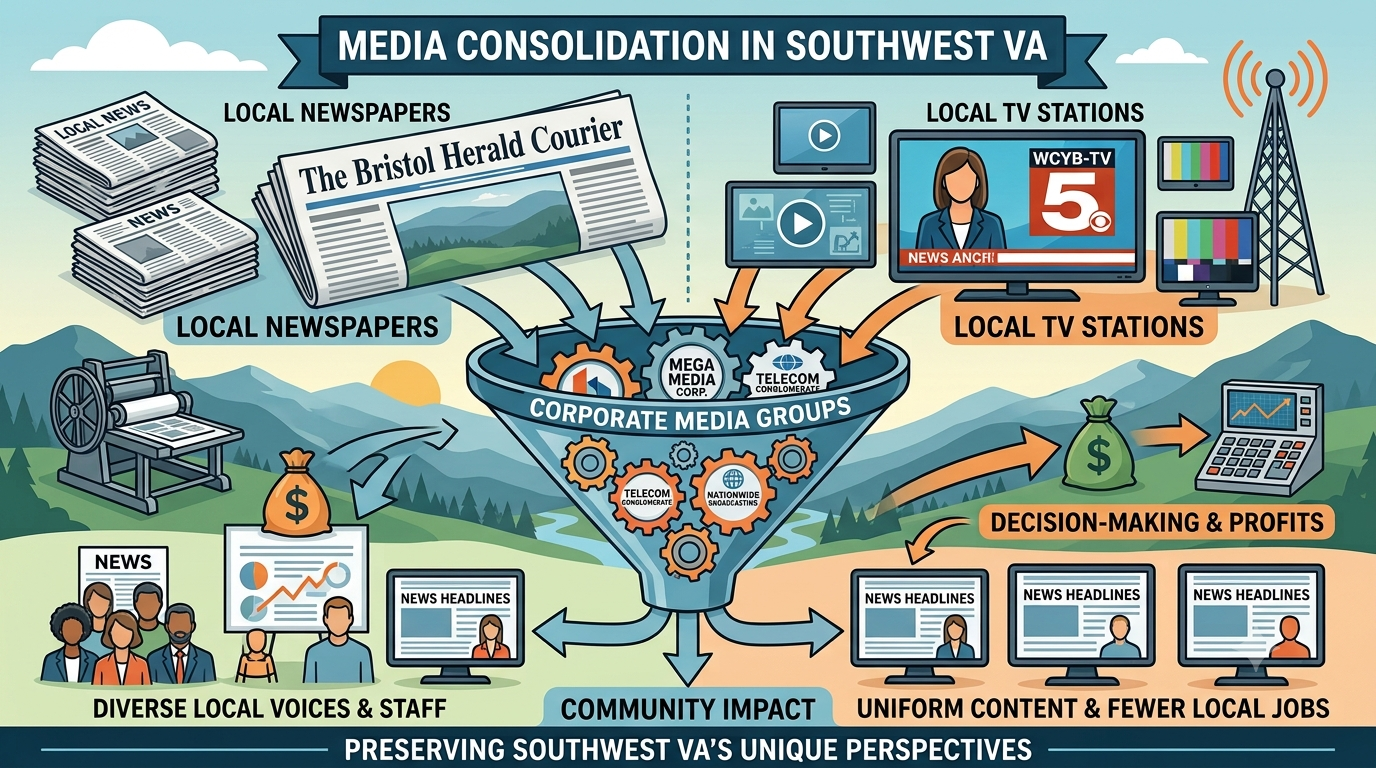
Who owns the news media around here? Almost nobody who actually lives here, not anymore. Two out-of-region companies own every network TV station in the Tri-Cities. An Iowa chain owns the Bristol Herald Courier along with most of the county weeklies. And on August 6, the FCC voted 2-1 to remove the last federal limit on how big those companies can get, killing the 39% cap that had capped how much of the country any single owner could reach.1 Chairman Brendan Carr called it overdue modernization. Commissioner Anna Gomez, the lone no vote, said only Congress can legally change that number, and warned the repeal just swaps “a squeeze from Big Tech for a squeeze from Big Media.”2
This didn’t happen in isolation. It’s the latest move in a pattern: broadcast deregulation, hedge funds buying up local newspapers, a $110 billion studio megamerger, the end of federal public broadcasting funding, and media companies making political concessions right as regulators decide their fate. Put together, it looks less like normal industry consolidation and more like the “media capture” playbook researchers have documented for years in places like Hungary, just run through funding cuts and regulatory leverage instead of outright takeover.
The FCC decision, briefly
Congress set the cap in 2004. Now the FCC reviews big ownership deals case by case instead. The winner here is Nexstar, the country’s largest TV station owner, which is trying to close a deal for rival Tegna that would push its reach to roughly 80% of U.S. households. Eight state attorneys general are suing to block it.3 Sinclair, the number two broadcaster, also stands to gain and called the repeal “common sense.”4
Newspapers never had a cap like this at all, which is part of why Alden Global Capital, a hedge fund known for gutting newsrooms, is now the country’s second-largest newspaper owner.5 Lee Enterprises, which owns most of the daily papers in our region, fought off an Alden takeover attempt in 2021.6
At the top of the industry, Paramount Skydance (controlled by David and Larry Ellison, backed by Gulf-state money) agreed in February to buy Warner Bros. Discovery, uniting CBS, CNN, HBO, and Warner Bros. under one roof for around $110 billion. Twelve state AGs sued to stop it.7
Where it gets ugly: media companies cozying up to the administration
Last September, after Jimmy Kimmel made comments about Charlie Kirk’s assassination, Carr publicly threatened broadcasters, saying the FCC could handle it “the easy way or the hard way.”8 Within hours, Nexstar and Sinclair both pulled Kimmel’s show, while their merger and licensing deals sat waiting on Carr’s desk. Senators Wyden and Warren sent both companies letters asking if they’d traded content for regulatory favors.9
A Paramount shareholder is now suing David and Larry Ellison, alleging they cut a side deal with Trump, including a promise to fire CNN anchors Trump doesn’t like, to get the WBD merger approved.10 Fox and News Corp remain Trump’s favorite megaphone and recently matched federal “Trump baby account” contributions for employees.11 Jeff Bezos ordered the Washington Post’s opinion page to focus on “personal liberties and free markets” right around the time his other company, Blue Origin, picked up billions in federal contracts. Elon Musk publicly cheered that move and has turned X into one of the administration’s main direct channels to the public.12
None of this proves an illegal quid pro quo. Most of it is still working through lawsuits and congressional inquiries. But the pattern, several companies making concessions right as they need something from the same administration, is exactly what press-freedom researchers flag as an early warning sign.
The Hungary comparison
Viktor Orbán ran this playbook in Hungary for 16 years: defund public broadcasting first, install regulatory loyalists, let allies buy up independent outlets, squeeze the rest financially.13 The comparison to the U.S. isn’t perfect. Our public media is spread across roughly 1,500 independent local stations instead of one broadcaster a government could just absorb, and courts here are already pushing back on some of these mergers. Worth remembering too: Orbán lost power this spring anyway.14 Media capture isn’t permanent. But it’s the same toolkit showing up here.
Our media market, in short
Two companies own every network TV station in the Tri-Cities: Nexstar (WJHL) and Sinclair (WCYB and WEMT).15 One local station, WKPT in Kingsport, is still independently owned.16 On newspapers, Lee Enterprises owns the Bristol Herald Courier and the Roanoke Times, both out of Iowa. Six Rivers Media, a locally owned company out of Kingsport, owns the Times-News and the Johnson City Press, though it folded the 156-year-old Jonesborough Herald & Tribune into the Press last year.17 Adams Publishing Group, a national chain, owns the Greeneville Sun.18
The county weeklies tell the same story more quietly. Lee runs the Washington County News, Smyth County News & Messenger, Wytheville Enterprise, Bland County Messenger, and Tazewell’s Clinch Valley News as one pooled regional operation on a shared website rather than as separate newsrooms.19 Over in the coalfields, the Coalfield Progress in Norton, The Post in Big Stone Gap, and the Dickenson Star changed hands again in 2024, sold by one out-of-region chain to another.19 The mastheads are still there. The independent newsrooms behind them mostly aren’t, and that costs us reporters who know a particular county’s school board, courthouse, and water system well enough to notice when something’s wrong.
Public radio here is structurally safer from buyouts, but not from money troubles. WETS-FM (Johnson City) and East Tennessee PBS both lost a real chunk of their budgets when Congress killed CPB funding in 2025, and both are leaning hard on donors now.20 On the Virginia side, WEHC out of Emory & Henry University carries Radio IQ, which is fed out of WVTF in Roanoke, so far Southwest Virginia still gets Virginia-focused public radio news, not just the Tennessee-side coverage.21 Both stations produce their own regional news coverage and carry shows of regional interest such as Inside Appalachia22.
What’s pushing back
Social media cuts both ways here. It’s how Musk amplifies the administration and how Trump himself issues his late-night tirades, but it’s also how Cardinal News, Virginia Mercury, and independent local journalists reach people directly, without needing a chain-owned paper or station to carry them. It’s not a fix for consolidated ownership, but it’s a real crack in the wall.
Two nonprofit outlets have grown into the gap. Cardinal News started in 2021 specifically because of newsroom cuts at chain papers in our region. It’s donor-funded, ad-free, and transparent about who gives, which puts it out of reach of hedge funds, but it’s also small and dependent on continued goodwill.23 Virginia Mercury is genuinely independent of corporate ownership, but it’s funded through States Newsroom, which traces back to progressive donor networks. Its statehouse reporting is solid, but it’s not a neutral alternative so much as a different funding source moving into the space chains left behind.24
Bottom line
The FCC’s repeal doesn’t hand Nexstar or Sinclair new stations here tomorrow. It just removes the last ceiling on how far that consolidation can reach, right as both companies have shown they’ll make content calls that line up with what the administration wants. Add in newspaper consolidation and the loss of public broadcasting funding, and Southwest Virginia looks like the national story in miniature: ownership narrowing into fewer hands, with less independent capacity locally to hold any of it accountable.
Footnotes
“FCC repeals national TV ownership cap, a win for Trump-aligned broadcasters,” CNN Business, Aug. 6, 2026. ↩
Same source. ↩
“FCC Eliminates TV Station Ownership Cap in Win for Nexstar and Other Big Broadcasters,” Variety, Aug. 2026. ↩
“FCC moves to deliver long-sought win for Trump-aligned broadcasters,” CNN Business, July 15, 2026. ↩
“Alden Global Capital makes push to buy Daily Herald in Chicago suburbs,” Local News Initiative, Northwestern University, Feb. 2026. ↩
“Lee Enterprises, owner of Roanoke Times, adopts ‘poison pill’ as it weighs Alden offer,” Roanoke Times, Nov. 2021. ↩
“PARAMOUNT TO ACQUIRE WARNER BROS. DISCOVERY,” Paramount press release, Feb. 27, 2026; “Paramount-Warner Bros Merger: What’s Next in States’ Antitrust Lawsuit,” Variety, July 2026. ↩
Warren Senate letter to Nexstar and Sinclair re: Jimmy Kimmel Live!, Sept. 23, 2025. ↩
“Wyden, Colleagues Demand Answers From TV Broadcasters After Pulling of Kimmel’s Show,” office of Sen. Ron Wyden, Sept. 2025. ↩
“David and Larry Ellison Sued by Paramount Investor Alleging ‘Illegal’ Side Deal With Donald Trump,” Variety, July 2026. ↩
“Rupert Murdoch’s News Corp, Fox Corp to match $1,000 investment in ‘Trump accounts,’” The Hill, Feb. 2026. ↩
“It’s Clearer Than Ever What Jeff Bezos Wants With the Washington Post,” Slate, March 2025; “Musk and Bezos Get Their Billion-Dollar Federal Contracts After Sucking Up to Trump,” Daily Beast, April 2025. ↩
“Documenting Hungary’s repression of independent media: A Q&A with Amrit Singh,” NYU School of Law, March 2026; Hungary country profile, Reporters Without Borders. ↩
“Media Capture Failed in Hungary, and America Could Be Next,” Amy Brouillette, Project Syndicate, May 2026. ↩
WJHL-TV, WCYB-TV, WEMT, Wikipedia. ↩
WKPT-TV, Wikipedia; FCC Public Inspection File. ↩
“Johnson City Press now part of Six Rivers Media, LLC,” Johnson City Press, 2020; “Jonesborough Herald & Tribune ceasing publication,” WJHL, July 2025. ↩
“Jones Media is sold to Adams Publishing Group,” Family Business Magazine. ↩
Lee Enterprises regional listings, swvatoday.com; “Three Southwest Virginia newspapers acquired by new owner,” Virginia Press Association, 2024. ↩ ↩2
“Billion-dollar funding cuts to PBS, NPR felt locally,” Kingsport Times-News, July 2025; “East Tennessee PBS awarded grant after federal funding cuts,” WJHL, Dec. 2025. ↩
“WEHC Widens Signal,” Emory & Henry news release, 2022; “Our Stations,” Virginia Public Radio. ↩
“Inside Appalachia,” https://wvpublic.org/podcasts/inside-appalachia/ ↩
“About Us,” Cardinal News, cardinalnews.org. ↩
“Virginia Mercury,” Influence Watch; States Newsroom, Wikipedia. ↩